I was talking recently with someone I worked with early in my career, when the two of us were putting closed-loop control into refineries. We started on GR00T N2, the robot foundation model NVIDIA previewed at GTC, and ended up talking about the things we used to commission twenty years ago.
The recent GR00T releases aim to handle objects, motions and environments beyond the robot demonstrations used in training. That is the capability we were discussing. I wanted to know what evidence and failure response would come with it when we put it on a real robot.
The GR00T N1.7 model card tells integrators to test with use-case-specific data and add guardrails before deployment. I agree with that advice. It also leaves the commissioning package to whoever downloads the model.
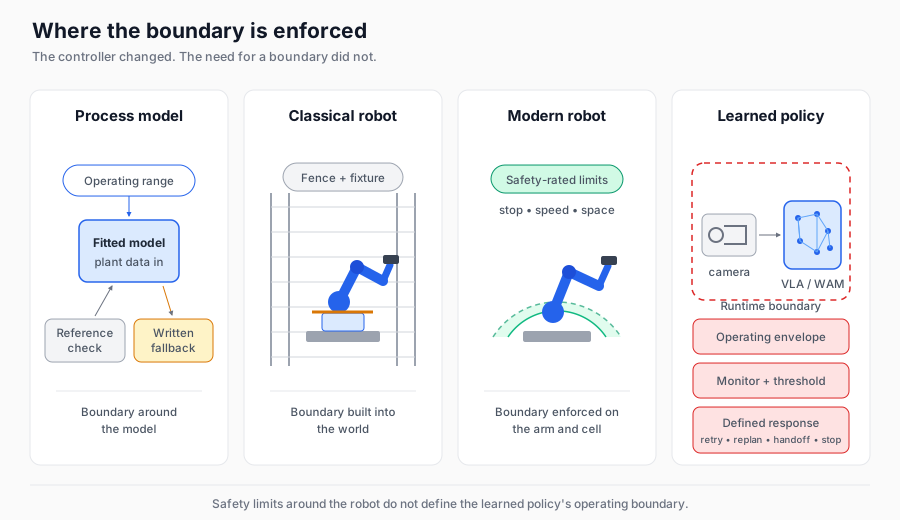
By commissioning package, I mean four plain things: the conditions where the model has been shown to work, a monitor and threshold for detecting when it may have left them, a defined response when that happens, and a clear rule for when it must be validated again.
The pattern was already there
On the systems I worked with, we programmed PID control in PLCs. I set three gains by hand and could usually explain why the output moved. The controller still had transmitter ranges, output limits, alarms and trips. Its assumptions were easy to see.
Model predictive control made more assumptions. We identified a process model from plant tests, gave it a prediction horizon and constraints, and let it choose the next move. Plant safety still sat in separate layers because the model could be wrong.
The clearest example for me was predictive emissions monitoring. A physical analyser in a hot, corrosive stack is expensive to keep healthy. In some installations, a model infers emissions from fuel flow, oxygen, load and temperature.
The model becomes usable after its operating envelope is established and it is checked against reference measurements. In the United States, EPA Performance Specification 16 says that predicted emissions outside the approved input envelope are not quality-assured. It also requires periodic accuracy checks.
I no longer have the procedure from the particular plant I worked on, so I am not going to recreate its exact fallback from memory. What I remember clearly is that an out-of-range result started a written procedure. It was not left to the model to decide whether its own answer was still acceptable.
The same separation between prediction and protection applied outside emissions monitoring. On one boiler-water train, high conductivity sent treated water to drain instead of storage. Silica had separate monitoring because conductivity alone was not enough. These rules sat outside the optimizer.
Industrial robotics put the same idea in a different place. Between about 2005 and 2010, I programmed Panasonic multi-axis robots using DTPS, its offline programming and simulation system, and the handheld teach pendant. We adjusted points at the cell, held parts in fixtures, controlled the lighting and kept people outside a fence. That controlled environment was part of what made the programmed motion dependable.
Modern robot systems add protections on the arm and cell. Safety-rated stops, speed limits and workspace limits are enforced independently of the learned policy. ISO 10218 covers that industrial robot integration work. Those protections matter, but they bound the robot and its cell. They do not tell me whether a learned policy is still operating in conditions that resemble its training and validation data.
With a learned policy, I still need to establish which conditions it can handle and what the cell should do when those conditions change. The arm’s safety limits do not answer that question.
The same boundary applies when a learned model sits inside a digital-twin decision loop rather than on a robot. In the room-surrogate case, a fast field prediction still needs domain checks, decision-quantity tests and a solver fallback before it earns any control authority.
A VLA is a class of robot policy, not a type of robot body. It may control a fixed arm, an autonomous mobile robot, a mobile manipulator, a humanoid or more than one embodiment. What that policy looks like depends on the body.
An autonomous mobile robot may only need conventional control for a fixed material-delivery mission. A learned policy becomes a different proposition when instructions, destinations or manipulation tasks vary. The commissioning question has to follow the actual body and task.
The gap around the policy
A VLA takes images, an instruction and robot state, then produces a chunk of actions. Its success can depend on material, friction, wear, lighting, contact and whether this connector is close enough to the ones in its data. A world-action model adds a prior about how scenes change over time. It still has to act through the same physical robot.
Many current policies also use a diffusion or flow-matching action head. Because inference typically starts from sampled noise, the same observation can produce different action chunks unless that sampling is controlled. Limits learned from data are not the same as constraints enforced by code or safety hardware. I am comfortable with both design choices, but they increase the work required around the policy.
I first thought very little of that work existed. That is no longer true. SAFE tests failure detection across several VLA architectures, while FORTRESS looks at using a runtime monitor to trigger fallback planning in robotic systems. Harness VLA comes closer to the operating-envelope question: can a memory-guided harness learn the range and failure models of frozen VLA primitives?
The direction is right. I still have not found a mainstream robot foundation model release that delivers these pieces together as a deployment contract. I get weights, code, benchmarks and a model card that tells me to build guardrails. I do not get a declared operating envelope, a signal and threshold for when the policy may have left it, a defined response, or a clear rule for revalidation.
When the model card says guardrails, I want to know what happens after the monitor detects a problem. Does the robot slow down, retry, replan, hand control back or stop? A signal that is only logged cannot change its behavior. In a lower-stakes agent workflow, I had to put the rule outside the model so the surrounding code could enforce it; here I would want the operating-envelope check connected to a defined response.
In process control, choosing the threshold was part of commissioning. With a robot, a tight threshold can cause enough nuisance stops that operators stop trusting it, while a loose one can miss the failure until the connector, product or fixture is damaged. The model builder can provide calibration data and a starting point, but the integrator has to weigh those consequences and test the response in the cell.
The evidence has two owners
I would ask the model builder and integrator for different evidence:
Scroll sideways for more columns.
| Question | Model builder provides | Integrator provides |
|---|---|---|
| Where was it valid? | Training and validation conditions; known blind spots | The actual task, cell and process envelope |
| What can be monitored? | Telemetry hooks, baseline detectors and calibration results | Force, quality, task-completion and equipment-state checks |
| Where is the threshold? | Detector performance across thresholds and a starting point | The operating point based on false trips and missed failures |
| What happens on failure? | Supported stop, retry and handoff interfaces | The retry, replan, review or stop procedure |
The contract also has to survive change. The model builder should identify known sensitivities and model-version changes that require retesting, and expose the model version and monitor output. The integrator should send changes to the camera, gripper, layout, material or process back through the validation and training loop, and retain field failures, nuisance trips and recovery results.
For connector insertion, the builder may supply a generic failure score and action telemetry. The integrator still has to define acceptable pose error, insertion-force behavior, final seating and cycle time, then decide whether a failed check means retry, send the part for review or stop the station. An AMR has a different set of checks: localization quality, blocked paths and whether it reached the intended line-side station. These policy guardrails sit alongside safety-rated controls; they do not replace them.
I do not expect one universal out-of-range detector. Deciding that a camera image is outside a training distribution is much harder than checking a conductivity limit. Part of this is still a research problem.
Even before the research is settled, a release could name the conditions it was validated in, its known blind spots, the external checks it expects and its fallback. Change the camera, gripper, action normalization or task, and it should also tell the integrator what needs to be checked again. Even an incomplete envelope gives the integrator something concrete to test.
Before putting the model on a live line, I would want to be able to walk through a failed check with both teams: what detects it, what the robot does next, and who has tested that response. A benchmark score cannot answer that for the cell I am commissioning.
Disclaimer: The views and opinions expressed in this account are those of my own and do not represent those of my employer, NVIDIA.